
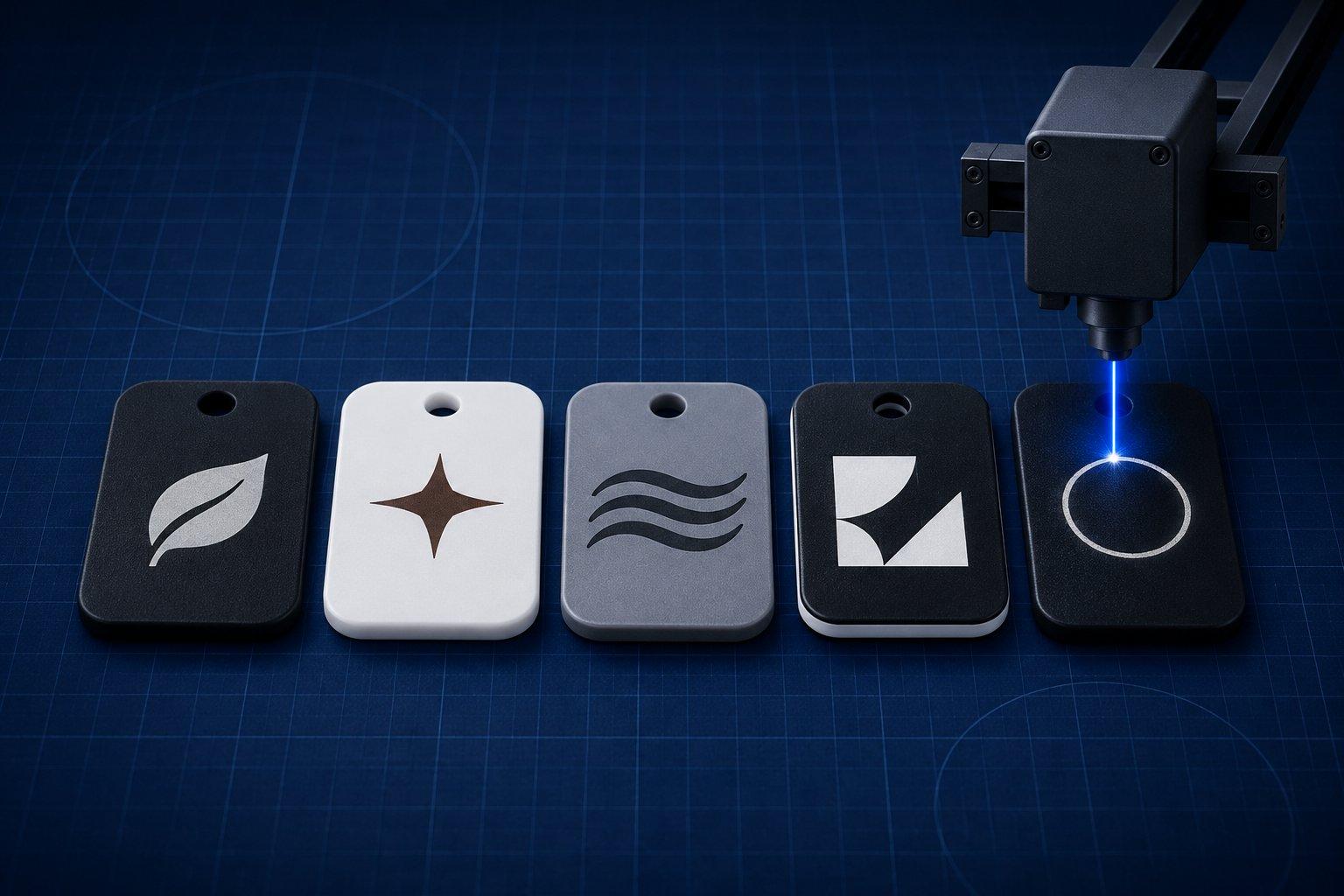
You can laser engrave plastic, but only plastic you have identified. Acrylic, acetal (Delrin), polyester film and purpose-made engraving laminate work well on a CO2 laser. PVC and vinyl must never be lasered because they release hydrogen chloride. ABS, polycarbonate, HDPE and polypropylene melt or char on hobby CO2 and diode machines and are better surface-marked with a fiber or UV laser.
"Plastic" covers dozens of unrelated chemistries, and the wrong one can corrode a machine in a single job or fill a room with something you should not breathe. The table below gives a verdict and a reason for each common plastic. If you cannot name the material in front of you, the verdict is no.
Which plastics are safe to laser engrave
Verdicts are for hobby and small-shop CO2 and diode machines. The last column says where a fiber or UV marker changes the answer.
| Plastic | Verdict | What happens and why | Better route |
|---|---|---|---|
| Acrylic (PMMA) | Safe | Engraves and cuts cleanly on CO2. Fumes are mainly methyl methacrylate. Flammable, so never unattended. | Diode needs dark, opaque sheet |
| Two-layer engraving laminate (acrylic-based) | Safe | Made for CO2. The beam removes a thin cap and exposes the core colour. | Confirm it is acrylic, not ABS |
| Acetal / Delrin (POM) | Safe with strong extraction | Clean cuts and detailed engraving on CO2. Heated POM gives off formaldehyde. | Fiber marks black acetal off-white |
| Polyester film, PET, PETG (Mylar) | Usable | CO2 cuts and marks it. Laser cutting PET releases aldehydes, including formaldehyde. | Clear sheet is invisible to diode and fiber |
| Polyimide (Kapton) | Usable | Listed as laser-compatible by Trotec and xTool. | |
| Nylon (polyamide) | Usable with care | Trotec lists it for CO2 cutting and engraving. Test first, results vary by grade. | UV marking |
| Polypropylene (PP) | Poor | Industrial systems process it, but on small machines it burns and melts. | UV marking |
| HDPE / polyethylene | Poor | Melts instead of engraving and can catch fire. | UV marking |
| Polystyrene (HIPS, foam board) | Avoid | Releases styrene. Many shop lists prohibit both the sheet and the foams. | Knife or router |
| Polycarbonate (Lexan, Makrolon) | Poor | CO2 chars and discolours the edge and leaves a yellow-brown mark. | Fiber gives a black mark |
| ABS | Not on hobby CO2 or diode | Thermal breakdown products include hydrogen cyanide and carbon monoxide. Fire risk. | Fiber or UV surface marking in an extracted enclosure |
| PVC, vinyl, most faux leather, Kydex | Never | Releases hydrogen chloride and vinyl chloride. Toxic, and it permanently corrodes the machine. | Rotary engraver, knife cutter |
| PTFE (Teflon) and other fluoropolymers | Never on hobby machines | Trotec lists PTFE as unsuitable because of toxic gases. | |
| Flame-retardant or unidentified plastic | Never | May contain chlorine or bromine. | Identify it first |
Acrylic gets its own guide, because sheet type and wavelength change the result so much. See laser engraving acrylic: cast vs extruded and which laser works for those details.
Why can't you laser engrave PVC or vinyl?
Because heating PVC releases hydrogen chloride gas, which is harmful to breathe and becomes hydrochloric acid on contact with moisture. Epilog states that hydrogen chloride and vinyl chloride from PVC cause irreversible damage to a laser system. xTool's safety guide adds ethylene dichloride and dioxins to the list of PVC emissions.
No setting makes this safe. Lower power still decomposes the surface, and extraction only moves the acid through your ducting and fan. PVC also hides under other names:
- Adhesive sign vinyl and many sticker films.
- Faux leather and "pleather", which are often PVC. The leather engraving guide covers what to use instead.
- Kydex, which Epilog names as containing PVC.
- Some self-adhesive backings, whose glue can contain chlorine.
PVC-free films sold as laser-safe do exist. Believe the safety data sheet, not the product title.
Can you laser engrave ABS?
Not safely on a hobby CO2 or diode laser. A literature review published by the US National Bureau of Standards (now NIST) found that the main toxic products of ABS thermal breakdown are carbon monoxide and hydrogen cyanide. xTool tells users not to cut or engrave ABS for that reason, and Emory University's prohibited-materials list adds fire risk.
The honest nuance is that industry marks ABS every day, with part numbers, logos and codes on housings and electronic components. Those are shallow surface marks made by fiber or UV lasers, typically inside enclosed, extracted marking stations. That is a different process from burning a relief into ABS sheet on an open gantry. Trotec and Thunder Laser both list ABS as markable, and Thunder publishes fiber, MOPA and UV starting settings for it (see the settings table below).
If you only own a CO2 or diode machine, choose acrylic-based laminate instead. Engraving suppliers sell ABS-based two-ply sheet for rotary engravers, and it looks almost identical to the laserable kind.
Can you laser engrave polycarbonate?
You can mark it with a fiber or UV laser, but a CO2 laser engraves and cuts it poorly. Universal Laser Systems' polycarbonate processing guide says edge discolouration cannot be avoided when cutting it with CO2, only reduced, and that CO2 marks come out yellow to light brown with a wide heat-affected zone. Epilog says the same about thin sheet: it cuts, and it discolours.
A 1,064 nm fiber laser is absorbed efficiently by polycarbonate and produces a dark brown to black mark with fine detail. Emissions are a second reason to keep it out of small machines: a study of laser cutting in the optical film industry measured phenols from polycarbonate. Polycarbonate and acrylic are both sold as clear sheet, so check which one you have. Lexan and Makrolon are polycarbonate. Plexiglas and Perspex are acrylic.
How to identify an unknown plastic
Work down this list and stop at the first step that gives a definite answer.
1. Paperwork
The supplier listing or the safety data sheet names the polymer. Epilog recommends checking the data sheet for exactly this reason. Sheet bought as "laserable" from an engraving supplier is the low-risk route.
2. The resin code on moulded parts
Bottles, tubs and many moulded items carry a number in a triangle. Under ASTM D7611 the number identifies the resin. It says nothing about recyclability.
| Code | Resin | Laser verdict |
|---|---|---|
| 1 | PET (PETE) | Usable on CO2 with extraction |
| 2 | HDPE | Poor: melts |
| 3 | PVC (V) | Never |
| 4 | LDPE | Poor: melts |
| 5 | PP | Poor: melts and burns |
| 6 | PS | Avoid |
| 7 | Other | Unknown. Could be polycarbonate, ABS, acrylic, nylon or a blend |
A 7 is not an identification. Sheet stock, offcuts and electronics housings usually carry no code at all, although housings are often stamped with letters such as ABS or PC.
3. The copper-wire test for chlorine
The Beilstein test screens for chlorine without a lab. The Canadian Conservation Institute's procedure is short: heat a bare copper wire in a torch flame until the flame shows no colour, touch the hot wire to a small fragment of the plastic, and return it to the flame. A green flare means chlorine, which means PVC or a related polymer.
Do it outdoors on a crumb of material, because the test itself makes fumes. Fingerprints and chlorinated fillers can give a false positive. A clean result only rules out chlorine. It does not tell you the sample is not ABS or polycarbonate.
4. When in doubt, don't
An unidentified offcut costs nothing to throw away. Corroded rails, a pitted lens and a workshop full of acid gas cost a great deal more. If the first three steps leave any doubt, cut it with a blade.
Which laser type marks which plastic
| Laser | Wavelength | Works on | Limits |
|---|---|---|---|
| CO2 | 10.6 µm | Engraving and cutting acrylic, acetal, polyester film and laminate in any colour, including clear | A thermal process. Melts polyolefins and chars polycarbonate |
| Blue diode | About 450 nm | Dark, opaque acrylic and two-tone sheet rated for diode | Clear, white and blue plastics do not absorb the beam |
| Fiber, including MOPA | 1,064 nm | Surface marks on ABS, polycarbonate, PET, PBT, black acetal and black acrylic | Contrast depends on pigments and additives. Clear plastics transmit the beam. Not a sheet cutter |
| UV | 355 nm | High-contrast marks on ABS, polycarbonate, PE, PP, PET and nylon with little heat | Low power. A marking tool, not a cutting tool |
CO2 is the general-purpose choice because nearly every plastic absorbs 10.6 µm, including clear sheet. Fiber and UV earn their place on the plastics CO2 handles badly. Keyence describes UV marking as cold marking: the short wavelength breaks chemical bonds at the surface instead of melting it, so polyethylene and polypropylene take a mark without special additives. The wider trade-offs between machines are in the fiber vs CO2 vs diode comparison.
Marking vs engraving plastic
Engraving removes material and leaves a recess. Marking changes the surface colour with little or no depth. Most fiber and UV work on plastic is marking, and Trotec's laser-marking guide names the mechanisms:
- Foaming: the beam melts the surface and gas bubbles form, which scatter light. This gives a light mark and is used mainly on dark plastics.
- Carbonising: the surface darkens. It gives strong contrast on light plastics and very little on dark ones.
- Colour change (staining): a reaction in the plastic or its pigment shifts the colour.
- Removing: the beam strips a top layer to show a contrasting layer underneath. This is how two-layer laminate and painted parts work.
Which one you get depends on the additives as much as the polymer. Universal Laser Systems notes that the carbon pigment in black Delrin absorbs the fiber beam and foams the surrounding polymer into an off-white mark. Two black parts from different moulders can therefore mark differently at identical settings. Pulse control helps: Trotec says a MOPA fiber laser gives more even and sometimes higher-contrast marks on plastics because the melting is better controlled.
Starting settings for engraving and marking plastic
These are published manufacturer starting points, not guarantees. Run a small test grid on scrap of the same material and colour first.
| Job | Laser | Starting point | Published by |
|---|---|---|---|
| Engrave two-layer laminate | 60 W RF CO2 | 35% power, 70% speed, 400 DPI, 1 pass | Rowmark |
| Engrave two-layer laminate | 40 W RF CO2 | 30% power, 80% speed, 400 DPI, 1 pass | Rowmark |
| Engrave acetal (Delrin) | 60 W RF CO2 | 30% power, 1,200 mm/s, 300 DPI | Thunder Laser |
| Cut 3 mm acetal | 60 W CO2 | 20 to 25 mm/s, up to 90% power | Thunder Laser |
| Cut 1.5 mm polyester film (Mylar) | 60 W CO2 | 70 mm/s, up to 90% power | Thunder Laser |
| Dark mark on ABS | 50 W fiber | 20% power, 1,000 mm/s, 50 kHz, 1 pass | Thunder Laser |
| Dark mark on ABS | 100 W MOPA | 23% power, 900 mm/s, 20 kHz, 92 ns pulse | Thunder Laser |
| Dark mark on ABS | 5 W UV | 3,000 mm/s, 70 kHz, 1 pass | Thunder Laser |
| Dark mark on polyethylene | 5 W UV | 400 mm/s, 30 kHz | Thunder Laser |
| Dark mark on polypropylene | 5 W UV | 100 mm/s, about 37 kHz | Thunder Laser |
| Dark mark on nylon (PA66) | 5 W UV | 300 mm/s, 30 kHz | Thunder Laser |
Thunder Laser's UV rows do not list a power percentage, so start low and work up. Its CO2 raster speed assumes a fast RF machine. On a slower gantry, reduce power in proportion. To steer from the first test:
- Mark too faint: slow down or add power in small steps. On a pulsed laser, a lower frequency puts more energy into each pulse.
- Yellow or brown halo, raised or bubbled surface: too much heat. Raise speed, lower power, or widen the line spacing.
- Melted, stringy edges on a CO2 cut: go faster in a single pass with air assist. If it still melts, the plastic is the problem, not the setting.
- Laminate warps: Rowmark advises lower power and DPI over more than one pass for large engraved areas, so the core can cool.
Do you need fume extraction to laser engrave plastic?
Yes, every time, including for the plastics rated safe. "Safe" means no acid gas and no cyanide. It does not mean clean air. Occupational measurements by France's INRS found that laser cutting had the highest potential to generate harmful substances of the plastic processes it studied, and recommended capturing fumes at the source.
Ventilation matters more than a mask. In a study of laser cutting PET and polycarbonate film, local ventilation alone removed up to 99% of the gaseous compounds. In practice:
- Run the job in an enclosed machine with the exhaust ducted outdoors, or through a fume extractor with both particulate and activated-carbon stages.
- Leave the lid closed until the smoke clears. Researchers at UCLA measured ultrafine particles escaping each time a laser cutter lid was opened after cutting acrylic.
- Wear eye protection matched to the wavelength. Clear plastics pass diode and fiber beams, so the beam continues to whatever is underneath.
- Stay with the machine. Several of these plastics melt, drip and can ignite.
Common failures and fixes
| Problem | Likely cause | Fix |
|---|---|---|
| No mark at all | The plastic is transparent to your wavelength (clear, white or blue on a diode; clear on fiber) | Change the laser type or the material, not the power |
| Raised, melted rim around the engraving | Too much energy, or a polyolefin (PE, PP) on CO2 | More speed and less power. For PE and PP, mark with UV instead |
| Brown, charred edge on clear sheet | The sheet is probably polycarbonate, not acrylic | Switch to acrylic for cutting. Mark polycarbonate with fiber |
| Sharp, acrid smoke and rust on the machine afterwards | The material contained chlorine | Stop. Clean the machine. Identify the stock before using it again |
| Low-contrast mark on a dark part | Carbonising on a dark plastic | Aim for a foamed, light mark instead: adjust frequency and speed, or try a MOPA or UV source |
| Laminate cap not fully removed | Underpowered or out of focus | Refocus, then add power in small steps |
Can a diode laser engrave plastic?
Yes, on dark, opaque plastics that are safe to laser, and not on clear, white or blue ones. A blue diode needs the material to absorb blue light. Black acrylic and diode-rated two-tone sheet work. Clear acrylic does not without a coating, and xTool's support pages list clear, white and blue acrylic as colours a blue diode cannot cut.
A diode does not change the chemistry. PVC is still forbidden, and ABS breaks down under heat into the same products whichever wavelength supplies that heat.
The practical verdict
Stock two plastics for a CO2 or diode machine: acrylic and acrylic-based engraving laminate. Add acetal if you need tough mechanical parts and have strong extraction.
Never laser PVC, vinyl or anything you cannot identify. Keep ABS, polycarbonate, polyethylene and polypropylene off gantry machines. If marking those is the job, that is the case for a fiber, MOPA or UV marker in an extracted enclosure.
Whatever the material, test on scrap, vent outdoors and stay with the machine.
Sources
- Trotec: What materials can a laser engrave, cut and mark?
- Trotec: Laser marking, basic know-how, terms and definitions
- Epilog Laser: What materials are unsafe to engrave or cut with the laser?
- xTool Support Center: Safety Guide, What Plastics Can Be Cut or Engraved?
- National Bureau of Standards (NIST): ABS pyrolysis and combustion products and their toxicity, NBSIR 85-3248 (PDF)
- Universal Laser Systems: Polycarbonate Processing Guide (PDF)
- Thunder Laser: Laser settings for cutting, engraving and marking (fiber, MOPA and UV tables)
- Canadian Conservation Institute: The Beilstein Test, CCI Notes 17/1